
Union Minister of Road Transport and Highways Nitin Gadkari on Tuesday unveiled the prototype of the world's first Bharat Stage (BS)-VI-compliant electrified flex-fuel car, developed by Toyota Kirloskar Motor. The car, which runs on 100 per cent ethanol (E100), is based on the Toyota Innova HyCross. It can cover 40 per cent of its distance on ethanol and the remaining 60 per cent on electric, with the petrol engine shut off.
The merged entity's deposits grew by 16.2 per cent YoY at Rs 20.63 trillion at the end of the first quarter. Sequentially, the merged entity's advances rose by about 0.7 per cent to Rs 22.30 trillion as of March 31, 2023. However, the pace of deposit mobilisation was higher at 1.2 per cent over Rs 20.39 trillion as of March 31, 2023.

Indian equity markets have a limited upside potential in the near-term as they negotiate the ensuing cyclical slowdown, wrote analysts at Nomura in a recent coauthored report led by Saion Mukherjee, their managing director and head of equity research for India. He, however, believes that the foundations are in place for sustainable growth over the medium-to-long term, and hence suggests a 'buy on dips' strategy to equity investors. As an investment strategy, Nomura prefers domestic-oriented sectors and companies over exporters, and prefers stocks that provide valuation comfort. Industrials and banks are their overweight sectors, while IT services and consumer discretionary are their underweight sectors.

Only one in four workers in Karnataka receive a salary, the lowest among the four industrialised states of India, a Business Standard analysis of the latest annual Periodic Labour Force Survey (PLFS) data shows. While 31.6 per cent workers in Gujarat receive regular wages (or salaries), followed by Tamil Nadu (30.3 per cent) and Maharashtra (29.4 per cent), only 25.7 per cent workers in Karnataka receive the same. The figure stands at 21.5 per cent at the national level, according to the 2021-22 PLFS data.

Ajay Banga will be a 'transformative leader', who will bring expertise, experience, and innovation to the position of World Bank President, United States President Joe Biden has said after the top Indian-American business executive was confirmed as the new head of the international lender.

From the Sensex pack, Mahindra & Mahindra climbed 3.81 per cent and Axis Bank advanced 2.68 per cent, followed by Tata Motors, Larsen & Toubro, Tata Steel, ICICI Bank, Reliance Industries, Maruti, IndusInd Bank and Sun Pharma. Asian Paints, Tech Mahindra, Nestle, Hindustan Unilever, Kotak Mahindra Bank and ITC were among the laggards.

India's exports in January dipped by 6.58 per cent to $32.91 billion, as against $35.23 billion in the same month last year, according to the data released by the commerce ministry on Wednesday. Trade deficit in January stood at $17.75 billion.

Experts foresee possible scenarios: A BRS government with less majority, a BRS government with BJP and AIMIM support, or a Congress government.

With an epic battle of billionaires for supremacy in one of the world's most prolific markets and a pandemic-propelled surge in online shopping in the background, India's nearly trillion-dollar retail market is hoping to touch 85 per cent of the pre-COVID business in the first half of the New Year. In a year when the COVID-19 carnage ripped apart the retail business, circa 2020 will best go down for the unravelling of the war between Jeff Bezos, the world's wealthiest man, and richest Indian Mukesh Ambani for pre-eminence in the booming market that is estimated to reach $1.3 trillion by 2025. It all started with Ambani's Reliance Industries agreeing in August to buy assets of the nation's second-largest retailer for Rs 24,713 crore, just a year after Bezos' Amazon purchased an indirect stake in the indebted Future Retail.

Coal, refinery products, electricity and cement production registered a growth of 14.5 per cent, 8.1 per cent, 10.2 per cent and 11.3 per cent, respectively in November, as per the data released by the Commerce and Industry Ministry.

The International Monetary Fund (IMF) warned on Tuesday that India's general government debt (comprising both central and state government debt) could exceed 100 per cent of gross domestic product (GDP) in the medium term. It also cautioned that long-term debt sustainability risks are high due to the significant investment required to meet India's climate change mitigation targets. The Indian government, however, disagreed, arguing that risks from sovereign debt are extremely limited as it is predominantly denominated in domestic currency.
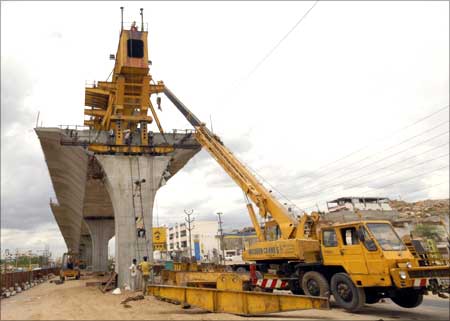
The growth rate was much higher a year ago at 8.7%.

'There is a need for a national task force with a singular objective to increase automotive exports.'

The sharp correction in the Indian markets from their peak levels has made valuations attractive, say analysts, who advise buying selectively, but only from a long-term perspective. Fifty-six of the Nifty 100 stocks, according to Mahesh Nandurkar, managing director at Jefferies, now trade below the 10-year historical averages, including stocks in financial, select auto, and pharma sectors. "Valuation (one-year forward consensus price-to-earnings, PE) has declined 25 per cent from October 2021 peak, almost matching the 33 per cent price-earnings contraction during the 2011 tightening cycle when repo rates went up by 375 basis points (bps) versus 250 bps this cycle.

Benchmark BSE Sensex rose by 156 points while the Nifty closed above the 17,300 level on Thursday after gains in metal, IT and capital goods shares amid foreign capital inflows. The 30-share BSE benchmark gained 156.63 points or 0.27 per cent to settle at 58,222.10. During the day, it jumped 513.29 points or 0.88 per cent to 58,578.76.

Foreign Direct Investment (FDI) equity inflows into India contracted by 14 per cent to $26.9 billion during the April-September this fiscal, according to the data of the Department for Promotion of Industry and Internal Trade (DPIIT). The inflows had stood at $31.15 billion during the corresponding period of the previous year. The total FDI inflows (which includes equity inflows, re-invested earnings and other capital) too declined to $39 billion during the first six months of the current fiscal year as against $42.86 billion in the year-ago period.

The Bahujan Samaj Party declared that it did not receive any donation above Rs 20,000 during 2021-22 as it has been declaring for the past 16 years, the ADR claimed.

Among major Sensex shares, PowerGrid fell the most by 2.76 per cent. IndusInd Bank dropped 2.34 per cent, HUL by 2.23 per cent and NTPC by 2.04 per cent. ICICI Bank, HDFC Bank, HDFC, ITC, Infosys, L&T, Bajaj Finance, Kotak Bank, HCL Tech and Tech Mahindra were among the losers. On the other hand, Tata Motors rose the most by 2.94 per cent, followed by Titan which gained 1.26 per cent. Mahindra & Mahindra, SBI and TCS were also among gainers.

Lured by the unprecedented growth in the real estate and boom in the stock market, banks exposure to these high risk sectors witnessed a whopping 75 per cent growth in 2005-06.

'Sector funds like IT funds should be included only in the satellite portfolio.' 'Limit your exposure to IT sector funds to around 5-10 per cent of your equity portfolio.'

'Investors don't have to worry about underperformance in passive funds, which earn market-equivalent returns.'

Investors' wealth eroded by Rs 3.46 lakh crore on Wednesday as equity markets took a sharp tumble amid weak global trends and foreign fund outflows. The 30-share BSE Sensex fell by 676.53 points or 1.02 per cent to settle at 65,782.78. During the day, it plunged 1,027.63 points or 1.54 per cent to 65,431.68. In line with the weak trend in equities, the market capitalisation of BSE-listed firms eroded by Rs 3,46,947.54 crore to Rs 3,03,33,258.69 crore.

Flipkart, the e-commerce company owned by Walmart, is intensifying its efforts to achieve profitability as it is eyeing a valuation of approximately $60 billion at the time of its initial public offering (IPO), now planned in 2025-2026, instead of this year, according to people familiar with the matter. The firm might consider listing in the US or any other geography, including India. The company, which counts the likes of Amazon and Reliance's JioMart among its competitors in India's burgeoning e-commerce market, had also contemplated launching an IPO in 2022-2023.

Nestle, Infosys, ICICI Bank, Tata Motors, Tata Consultancy Services, HCL Technologies, Tech Mahindra and Axis Bank were the other major winners. Sun Pharma, Asian Paints, Bajaj Finance and Titan were the laggards.

Stocks of new-age companies have seen a mixed performance thus far in calendar year 2023 (CY23). While those of One97 Communications (parent company of Paytm), PB Fintech and Zomato have surged up to 63 per cent year-to-date (YTD), FSN e-commerce, the parent company of Nykaa, however, has dropped 14 per cent YTD. By comparison, Nifty50 and Nifty 500 indices have advanced 7 per cent and 8.7 per cent, respectively, during the period, ACE Equity data show.

After a sharp outperformance in the mid-and small-cap segments in the first half of calendar year 2023 (H1-CY23), analysts are now turning cautious on these two market segments and suggest investors stay selective and look for valuation comfort and earnings visibility before investing. The S&P BSE Midcap index has surged 13.7 per cent in H1-CY23, and the S&P BSE Small-cap index gained 12.7 per cent during this period, data shows. The S&P BSE Sensex, in comparison, has moved up 6.4 per cent.

Of the 3,893,149 registered applicants on the MP Rojgar portal, only 21 individuals have been successfully placed in government and semi-government positions since April 2020.

A round-up of Day 2 of the Ranji Trophy matches played on Sunday

The miscreants behind these hoax threats, which even prompted evacuations in hospitals and shopping malls, are yet to be identified. FIRs have been lodged in connection with some of the incidents, according to officials.
India's economic growth slowed down to 4.4 per cent in the third quarter of 2022-23 mainly due to poor performance of the manufacturing sector. In October-December 2021, the economy grew by 11.2 per cent and by 6.3 per cent in the July-September 2022 quarter, according to data released by the National Statistical Office (NSO) on Tuesday.

The retail industry witnessed robust top-line growth for the greater part of the previous financial year, but demand has started to show signs of fatigue seen in the January-March quarter (fourth quarter, or Q4) of 2022-23 (FY23), especially in the apparel and innerwear segments. Jewellery, however, has managed to hold on to demand in the quarter. "In the discretionary space, demand moderation in urban markets is expected to impact the quick-service restaurant and apparel categories the most, while paint, luggage, and jewellery should see resilient growth," Systematic Institutional Equities observed in its preview of the sector.

Rising prices of cereals and concerns over rice production in the 2023-2024 crop year due to insufficient rains followed by floods could be the possible causes.

'We suggest an equity strategy of 5% to 10% exposure to cash, 5% to Gold ETF, close to 50% to Sensex/Nifty/large mid-cap stocks.'

Clawing the economy back to an 8 per cent growth path will require bringing savings and investment rates closer to 35 per cent on a sustained basis, which were 30.2 and 29.6 per cent, respectively, in FY22, according to a report. As per India Ratings, a large part of investments will have to be in infrastructure, which can help revive private investments by easing supply constraints and offset the weakening of external demand due to global headwinds. Higher investments will have to be accompanied by higher domestic savings to keep the savings-investments gap under check.
Sectors like the BSE IT, Bankex, FMCG, Healthcare and Oil indices, which gained sharply today, were obviously the ones that drove the Sensex to 12K.

Investors became poorer by Rs 1.36 lakh crore on Friday as the markets witnessed a sell-off amid weak global trends. Benchmark stock indices Sensex tanked 671.15 points or 1.12 per cent to close at 59,135.13, as 21 of its scrips declined. The sharp decline in equities eroded Rs 1,36,037.96 crore from the market capitalisation of BSE-listed firms and that now stands at Rs 2,62,94,723.65 crore.

During April-May, growth in the eight core industries slowed to 3.3 per cent as against 4.9 per cent in the year-ago period.

Margins for the oil refining and retailing sector have moved off their peaks, and the average integrated margins (refining plus marketing) for oil marketing companies (OMCs) have normalised. The ascent in crude oil prices, combined with static retail prices, has depressed marketing margins for diesel and petrol. However, the fall in marketing margins has been offset by increased gross refining margins (GRMs).

Despite a 187 km, seven-line metro network carrying 2.4 million commuters every day, private vehicles rose 92% over the last 15 years

Retirement fund body EPFO added 16.26 lakh subscribers on a net basis in November 2022, which is 16.5 per cent higher compared to a year ago, the labour ministry said on Friday. The provisional payroll data of Employees' Provident Fund Organisation (EPFO) released on Friday by the ministry highlighted that the EPFO has added 16.26 lakh net members in the month of November 2022. The data indicate a 25.67 per cent increase in net additions compared to the previous month in October 2022, a labour ministry statement said.
